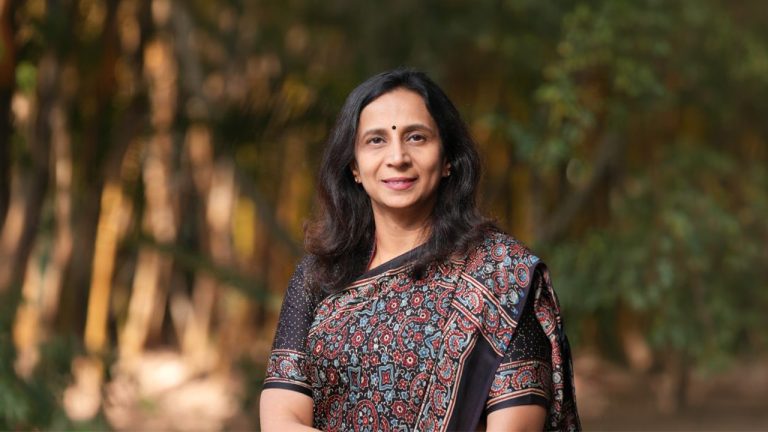
A conversation with Dr. Srivardhini K Jha, Independent Director, Expleo Solutions Limited (a company of Expleo), and recipient of the Bharat Asmita Acharya Shreshtha Award.
Interview by Bharath Kumar Rangarajan,
Head of Marketing and Communications, Asia, Expleo.
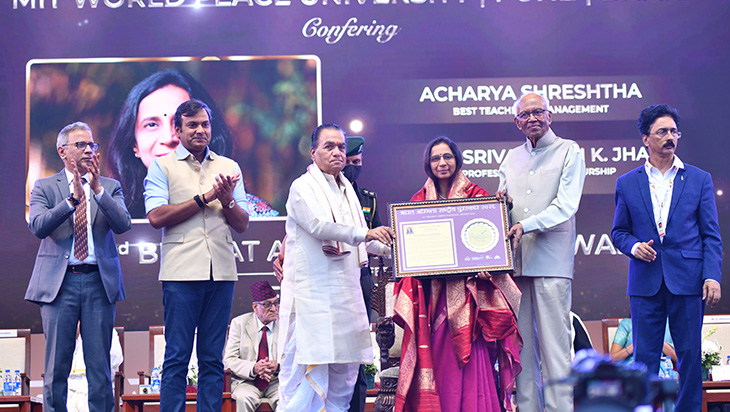
When MIT World Peace University conferred upon Dr. Srivardhini K Jha, the Bharat Asmita Acharya Shreshtha Award, a prestigious national honour, it was easy to see the achievement as hers alone. Dr. Jha sees it differently. A scholar, an educator, former chairperson of the Indian Institute of Management Bangalore’s startup incubator NS Raghavan Centre for Entrepreneurial Learning (NSRCEL), and a recipient of the National Teachers Award 2025. She brings the same rigour and quiet generosity to a candid conversation about recognition, relevance, and reinvention in the age of AI.
Congratulations on this honour. What does this recognition mean to you, and how has teaching shaped your leadership philosophy?
It is humbling, genuinely. I see this not as an individual achievement, but a reflection of the curiosity and questioning of the students I have taught, the passion and perseverance of the entrepreneurs I have mentored, and the calibre of colleagues with whom I have had the privilege of working. From all of them, I have received far more than I have given.
In my view, recognition often celebrates individuals. Leadership, however, is rarely individual. The equation between teaching and leading is deeply symbiotic; what you do impacts how you teach, and what you teach shapes how you lead. The classroom and the boardroom are not separate worlds. Each keeps you honest in the other.
“From my students, entrepreneurs, and peers, I have received far more than I have given.”
How do you personally stay updated , and what are the core skills that matter most in an AI-enabled future?
That is the defining question of our time, isn’t it? Everyone has a phone and access to AI. The real question is: what do you bring to a conversation that AI cannot? My answer is depth. Breadth is necessary, but when information is equally accessible to everyone, breadth alone will not distinguish you. Anyone can retrieve an answer. Very few can see the pattern behind it. That is the difference between information and insight, and insight comes only from people willing to go deeper, understanding how to connect the dots others miss.
We must think of AI as a collaborator, a thought partner. Professionals who thrive will be those who bring judgment, curiosity, and ethical reasoning to the table and use AI to sharpen that. You need both technical and behavioural skills, but it is the behavioural shift that makes the technical one possible.
“Breadth is table stakes. Depth is the differentiator.”
Do you think we need to rethink how we structure careers? What needs to change, and where do women fit in that picture?
We need to start by questioning the entire model of work we have inherited. Study till 22, work till 60, and then retire is designed for a world that no longer exists. Thanks to modern medicine, people are living longer and healthier lives. If you retire at 60 in excellent health, what will you do for the next two to three decades? That question has no satisfying answer under the current model.
And if you are going to work for 50 years, you cannot possibly do the same thing throughout. You will need to pivot, reinvent, and acquire new skills and look at your career, not as a single trajectory but a series of chapters, each distinct, each building on the last in ways that are not linear. I think the punctuated careers are the new normal, an unavoidable reality for everyone.
For women, this matters in a very specific way. The old model stacked prime professional years directly on top of peak family years. Extend the professional horizon to 50 years, and that overlap becomes one chapter in a much longer story. A woman who returns to work at 40 or 45, with fresh perspectives and settled familial responsibilities, can be among the most productive professionals. But only if the system is built to receive her back. That is where corporations, governments, and institutions are still falling short.
And it goes beyond individual careers. When people are supported by learning and contributing across all phases of life, it directly impacts the communities around them. For instance, the startups they advise, the professionals they mentor, the policy conversations they shape and so on. Corporations and governments have a real responsibility here: not just to open doors for re-entry, but to invest in the conditions that make it possible.
“The pause is not the problem. The system that treats it as one is.”Why this conversation matters at Expleo
Dr. Jha’s thinking on deep work, AI, and career architecture maps directly onto how Expleo is building for the future through initiatives like organisation-wide continuous learning, through deliberate investment in women-focused hiring and development programmes, and through a conviction that professionals who will lead in this industry are those who go deeper, not just faster. Having an independent director who brings together academic insight, real-world experience, and boardroom perspective is intentional. And conversations like this help make that value visible.
If you’re ready to join an organisation where values are more than just words, take a look at our current opportunities.